
Finding a telescope that survives a child’s enthusiasm while still delivering a clear view of the moon isn’t as straightforward as the toy aisle makes it look. Magnification specs, aperture size, and mount stability all determine whether a first stargazing session ends in wonder or frustration. This review breaks down three leading options – the Gskyer 70mm 400mm AZ Refractor, the Blue Marble NASA Lunar Telescope 90x, and the ToyerBee 70mm Refractor – so you can match the right scope to your kid’s age, patience level, and your budget.
Quick Comparison
| # | Product | Key Features | Score | |
|---|---|---|---|---|
| 1 |
 Gskyer 70mm 400mm AZ Refractor Telescope with Remote |
|
7.8 ★★★★☆ | Read full review ↓ |
| 2 |
 Blue Marble NASA Lunar Telescope 90x Kids Beginner |
|
7.5 ★★★★☆ | Read full review ↓ |
| 3 |
 ToyerBee 70mm Refractor Telescope with Phone Adapter |
|
7.4 ★★★★☆ | Read full review ↓ |
| 4 |
 Jvcla Kids Telescope 20X-40X with Compass |
|
7.2 ★★★★☆ | Read full review ↓ |
| 5 |
 Koolpte Kids Telescope 50mm Aperture with Tripod |
|
7.2 ★★★★☆ | Read full review ↓ |
| 6 |
 Luzsco 50mm 100x Kids Beginner Telescope with Tripod |
|
6.5 ★★★☆☆ | Read full review ↓ |
| 7 |
 Luzsco 50mm Kids Beginner Telescope with Tripod |
|
6.5 ★★★☆☆ | Read full review ↓ |
| 8 |
 Sobrzy Kids Telescope 50mm Aperture 100x Magnification |
|
6.5 ★★★☆☆ | Read full review ↓ |
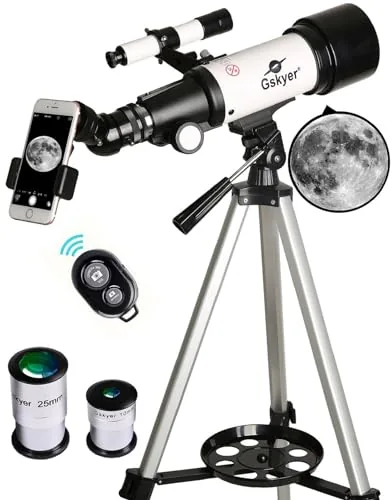
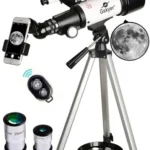
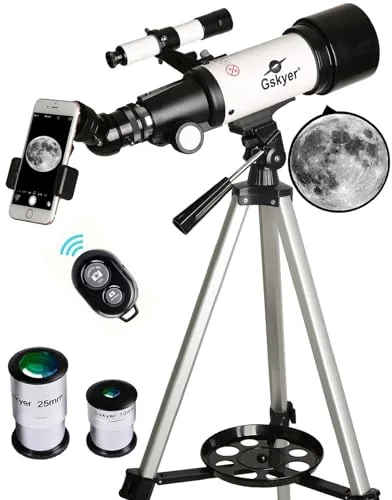
Gskyer 70mm 400mm AZ Refractor Telescope with Remote
A 70mm aperture refractor built for beginners who want usable lunar and planetary views without a steep learning curve. The included smartphone adapter and wireless remote make it straightforward to capture and share what you see. At under $100, the carry bag and adjustable tripod add genuine portability to the package.
Key Features
- 70mm aperture, 400mm focal length, fully coated glass optics
- Two eyepieces plus 3x Barlow lens for up to 3x magnification boost
- 5×24 finder scope with crosshair lines for locating targets
- Smartphone adapter and wireless camera remote included
- Adjustable aluminum alloy tripod with multiple viewing positions
- Carry bag fits telescope and tripod for travel and storage
✅ Pros
- 70mm aperture collects enough light for clear moon and bright planet views
- 3x Barlow lens effectively triples each eyepiece magnification without extra cost
- Wireless remote reduces camera shake when photographing through a smartphone
- Carry bag makes transport to dark-sky sites practical
- Tripod height is adjustable to suit different users and viewing angles
❌ Cons
- 400mm focal length limits deep-sky performance on faint nebulae and galaxies
- AZ mount requires manual tracking as objects drift across the field
Why We Chose It
The combination of a 70mm aperture, included Barlow lens, and smartphone remote gives beginners a complete starter kit without buying accessories separately. The carry bag is a practical inclusion that most competitors at this price omit. These factors make it a stronger value than bare-bones alternatives in the same range.
Perfect For
A parent buying a first telescope for a child or teenager who wants to observe the moon and planets at home or on camping trips.
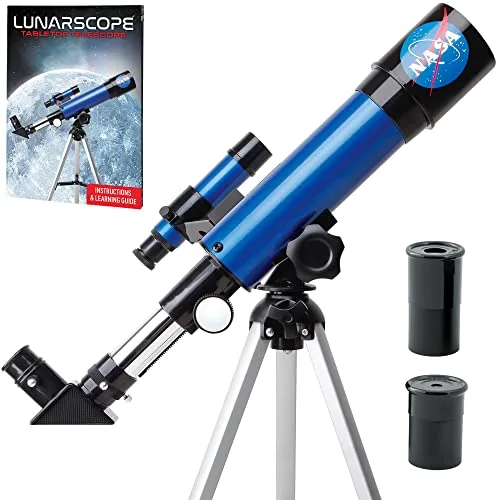
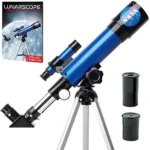
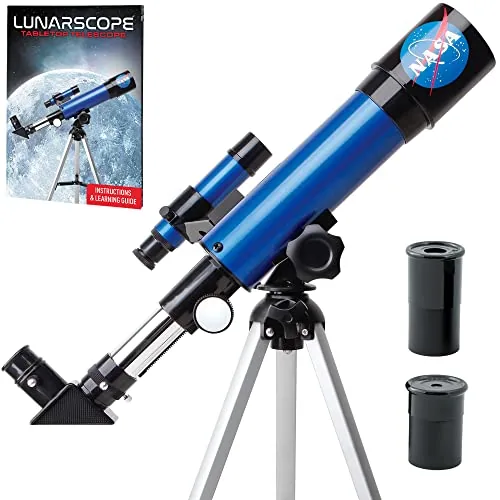
Blue Marble NASA Lunar Telescope 90x Kids Beginner
A purpose-built moon telescope for children aged 8 to 12, shipping with two eyepieces that reach 90x magnification and a finder scope to help locate targets before zooming in. The tabletop tripod keeps the view stable on a desk or outdoor table. At $44.99 it covers the core gear a beginner needs without requiring extra purchases.
Key Features
- Optical glass lens with finder scope for locating targets
- Two eyepieces provide low and high power up to 90x magnification
- Tabletop tripod with smooth pan mount for stable lunar scanning
- Designed for straightforward assembly by children and parents
- Amazon-exclusive product from Blue Marble
✅ Pros
- Two included eyepieces let kids start at low power then zoom to 90x without buying extras
- Finder scope reduces the frustration of locating the moon before switching to high magnification
- Tabletop tripod keeps the setup compact and usable indoors or on a flat outdoor surface
- Price stays under $50 with all core accessories included
❌ Cons
- Tabletop tripod limits viewing height so floor-level or ground use is awkward outdoors
- 90x maximum magnification is sufficient for the moon but rules out serious planetary detail
Why We Chose It
This telescope ships with every piece a first-time user needs, finder scope, two eyepieces, and a tripod, so a child can be observing the moon the same evening it arrives. The optical glass construction puts it above cheap plastic-lens alternatives at a similar price. The lunar focus keeps the learning curve short and the early successes frequent, which matters for keeping kids engaged.
Perfect For
A child aged 8 to 12 who wants their first real look at the moon’s craters and surface detail without a complicated setup.
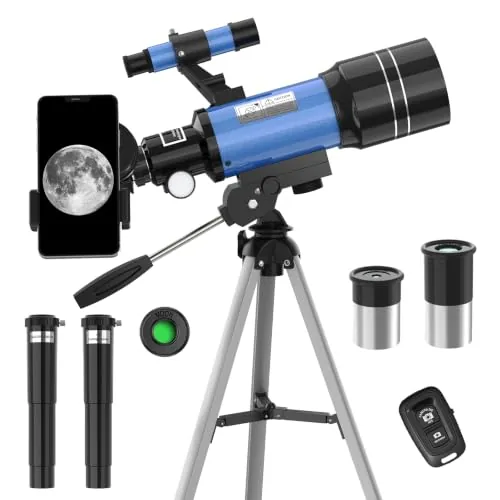
ToyerBee 70mm Refractor Telescope with Phone Adapter
A 70mm aperture and 300mm focal length give this refractor enough light-gathering for clear views of moon craters, Saturn’s rings, and Jupiter at 150x magnification. The included phone adapter, wireless remote, and adjustable tripod make it easy to photograph what you see without additional purchases. At under $60, the accessory bundle covers everything a first-time user needs to get outside and start observing the same night.
Key Features
- 70mm aperture and 300mm focal length with fully multi-coated glass
- 15x to 150x magnification via two eyepieces and 3x Barlow lens
- Includes phone adapter, wireless remote, and adjustable tripod
- No-tool setup with star chart included for beginners
- Lightweight build suited for camping and outdoor use
✅ Pros
- Full accessory kit included at the base price with no upsells needed
- Fully multi-coated optics improve light transmission noticeably over bare glass at this price tier
- 150x ceiling is enough to resolve Saturn’s rings and lunar surface detail
- Wireless remote reduces camera shake when shooting through the phone adapter
❌ Cons
- 300mm focal length limits wide-field deep-sky viewing compared to longer tubes
- Plastic focuser and mount feel less rigid than metal alternatives above $100
Why We Chose It
The combination of a 70mm aperture, fully multi-coated glass, and a complete accessory package at $59.98 gives new astronomers more starting capability per dollar than most bare-tube competitors in this range. The wireless remote is a practical addition that similar kits often omit, making phone astrophotography more usable from the first session.
Perfect For
Parents buying a first serious telescope for a child aged 10 and up, or adults wanting a lightweight grab-and-go scope for camping trips away from city light pollution.
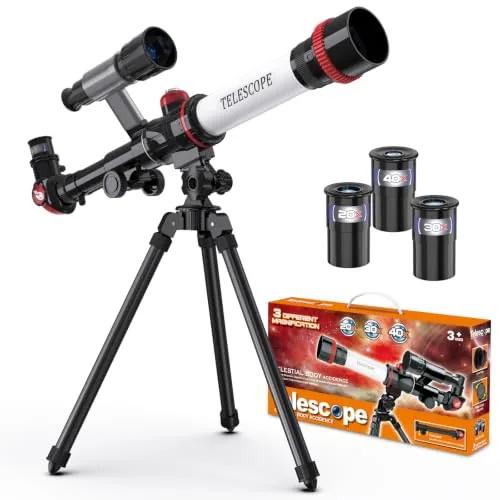
Jvcla Kids Telescope 20X-40X with Compass
A starter refractor telescope aimed at children 8 to 12, shipping with three swappable eyepieces that cover 20X to 40X magnification. The included compass and finderscope help kids orient and locate targets without adult hand-holding. At under $30 with colorful gift packaging, it fills a clear gap between toy binoculars and serious beginner scopes.
Key Features
- Three eyepieces provide 20X to 40X magnification range
- Finderscope and compass aid target location outdoors
- Adjustable tripod supports multi-angle indoor and outdoor use
- Tool-free assembly designed for children to complete independently
- Colorful gift box suits birthdays and holiday giving
✅ Pros
- Three eyepieces give meaningful magnification range for the price
- Compass and finderscope reduce frustration when locating objects
- No-tool assembly lets kids participate from the start
- Portable size works for backyard use and travel
❌ Cons
- Plastic optics limit image sharpness compared to glass-lens scopes
- Maximum 40X magnification is low for serious moon detail
Why We Chose It
The combination of a finderscope and compass at this price point is uncommon and directly addresses the biggest frustration beginners face, which is finding anything in the first place. Three included eyepieces mean a child can experiment with magnification rather than being locked into one setting.
Perfect For
Parents buying a first telescope for a curious 8 to 12 year old who wants to look at the moon, distant landscapes, and wildlife without a steep learning curve.
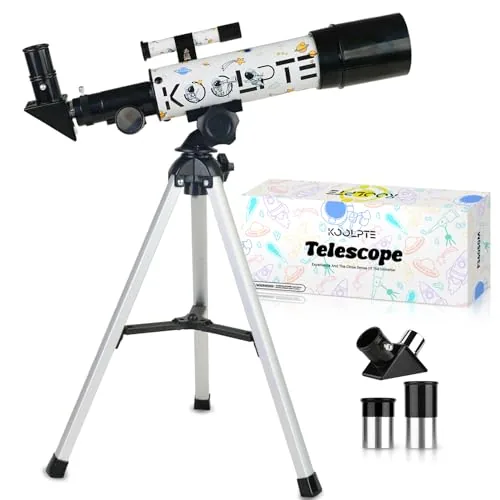
Koolpte Kids Telescope 50mm Aperture with Tripod
A 50mm aperture refractor telescope sized and simplified for children as young as 3. Two swappable eyepieces let kids start wide then zoom in, while the included finder scope reduces the frustration of locating targets. The aluminum tripod and altazimuth mount keep setup straightforward for parents.
Key Features
- Designed for children ages 3 and up, day or night use
- Two eyepieces included for low and high magnification views
- Finder scope simplifies aiming before looking through main lens
- Aluminum tripod with altazimuth mount for vertical and horizontal movement
- Learning guide covers Moon phases, eclipses, and surface features
✅ Pros
- 50mm aperture is functional for Moon craters and distant daytime objects
- Two-eyepiece system teaches kids the locate-then-magnify workflow used by real observers
- Aluminum tripod is more durable than the plastic alternatives common at this price
- Bundled learning guide ties observation to actual science content
❌ Cons
- At $39.99 the optics will show chromatic aberration on high-contrast targets like the Moon
- Recommended age of 3 is optimistic for solo use; a parent will need to assist most sessions
Why We Chose It
For under $40, this telescope includes hardware that entry-level toy telescopes typically omit: a finder scope, two eyepieces, and a metal tripod rather than a plastic one. The learning guide adds classroom-style context that justifies the educational toy framing without being the only thing in the box worth using.
Perfect For
Parents of children aged 5 to 10 who want a first telescope that teaches real observation habits without a steep price commitment.
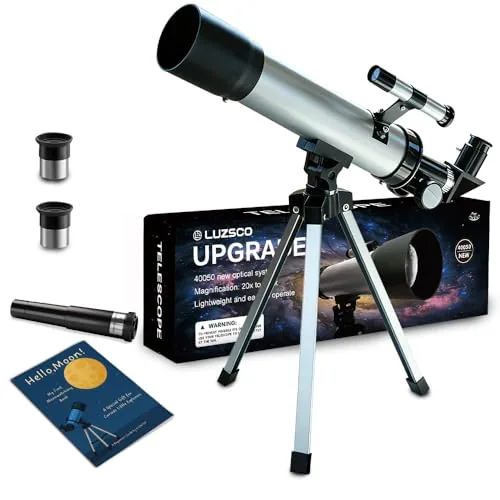
Luzsco 50mm 100x Kids Beginner Telescope with Tripod
A 50mm refractor telescope sized for children ages 6 to 12, supplied with two eyepieces (6mm and 20mm), a Barlow lens, finderscope, and tripod for under $27. The included Moon Observation Guide gives kids structured activities to follow rather than leaving them to figure out what to look at. Assembly is part of the experience, making it useful for parent-child STEM sessions.
Key Features
- Beginner refractor designed for kids ages 6 to 12
- Assembly and experimentation build basic STEM problem-solving skills
- Moon Observation Guide included with structured activities for kids
- Suitable gift for birthdays, holidays, camping, and screen-free play
- Kit includes tripod, finderscope, 6mm and 20mm eyepieces, Barlow lens
✅ Pros
- Complete starter kit under $27 with no extra purchases needed
- Two eyepieces plus Barlow lens give magnification options from moderate to 100x
- Moon Observation Guide provides structured direction for first-time users
- Assembly process doubles as a hands-on learning activity for kids
❌ Cons
- 50mm aperture limits views to the Moon and bright planets only
- Build quality typical of sub-$30 toys may not withstand rough handling
Why We Chose It
At $26.99, this kit includes more accessories than most comparable beginner sets, specifically the dual eyepieces and Barlow lens that allow meaningful magnification variation. The Moon Observation Guide is a practical addition that gives children a concrete starting point rather than an open-ended guessing exercise. For parents wanting a low-cost introduction to astronomy without buying accessories separately, the bundle holds reasonable value.
Perfect For
Parents buying a first telescope for a 6 to 12 year old who wants to observe the Moon and learn basic setup skills without a large upfront investment.
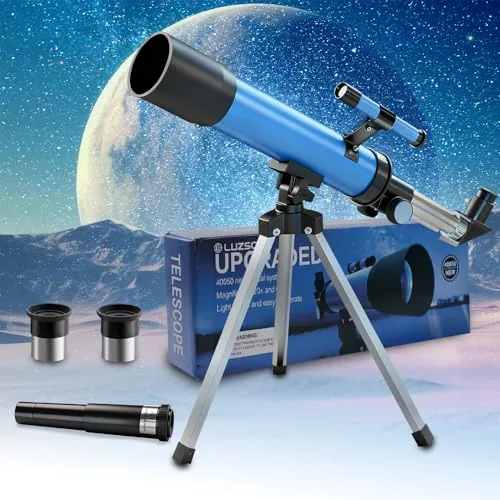
Luzsco 50mm Kids Beginner Telescope with Tripod
A $29 entry-level telescope sized for kids 6 to 12, with two eyepieces, a Barlow lens, and a finderscope included. Assembly is part of the experience, giving children a hands-on task before they ever point it at the sky. It works as a low-stakes first telescope for backyard moon and daytime viewing.
Key Features
- 50mm aperture beginner telescope for kids ages 6 to 12
- Includes tripod, finderscope, 6mm and 20mm eyepieces, and Barlow lens
- Assembly process builds problem-solving and patience skills
- Screen-free activity suited for backyard, camping, and family use
- Designed as a STEM gift for birthdays and holidays
✅ Pros
- Complete kit at $29 requires no separate accessory purchases
- Two eyepieces plus a Barlow lens give kids multiple magnification options to compare
- Assembly step adds an educational layer before first use
- Portable tripod makes it usable indoors and outdoors
❌ Cons
- 50mm aperture and budget optics limit useful magnification to lower power settings
- Build quality at this price point may not survive rough handling by younger children
Why We Chose It
At $28.99 it covers the basics a first-time young astronomer needs without a significant financial commitment. The two-eyepiece setup lets kids experiment with magnification, which keeps engagement higher than a fixed single-eyepiece design. It is a reasonable gift for a child showing early curiosity in astronomy before investing in a higher-quality instrument.
Perfect For
Parents who want an affordable first telescope for a 6 to 10 year old curious about the moon and stars, with no prior astronomy experience in the household.
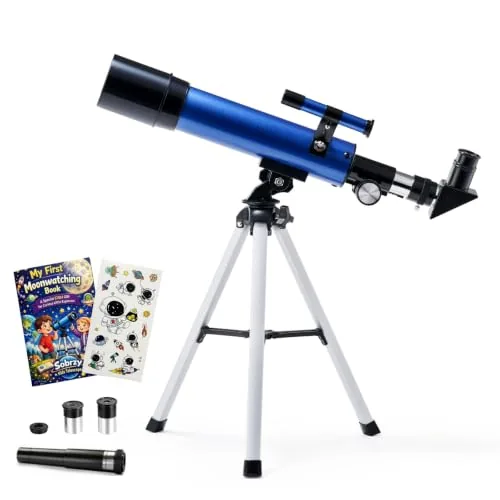
Sobrzy Kids Telescope 50mm Aperture 100x Magnification
A 50mm aperture refractor telescope aimed at children aged 8 to 12, covering magnification from 20x up to 100x. It ships with a tripod, finder scope, and two eyepieces so kids can start observing the moon and bright planets without buying extras. At under $28, it sits at the low end of beginner astronomy gear in terms of both price and optical capability.
Key Features
- Designed for ages 8 to 12, easy setup for first-time users
- 20x to 100x magnification via 50mm aperture and 400mm focal length
- Includes tripod, finder scope, and two eyepieces in one kit
- Aimed at STEM learning through hands-on astronomy observation
- Portable enough for backyard use, camping, and outdoor sessions
- Packaged as a gift option for birthdays and holiday occasions
- Positioned as an entry-level space and science kit for kids 8 to 12
✅ Pros
- Complete starter kit under $28 with no additional purchases required
- Two included eyepieces allow kids to switch between lower and higher magnification
- Lightweight and portable for outdoor use or travel
- Finder scope helps beginners locate objects before zooming in
❌ Cons
- 50mm aperture limits usable detail at 100x, moon and bright planets are realistic targets but deep-sky objects will disappoint
- Tripod and focuser quality at this price point often require patience and adult help to get sharp views
Why We Chose It
It covers the core requirements for a first telescope without requiring a child or parent to source separate accessories. The 20x to 100x range is appropriate for lunar observation, which is the most rewarding target for beginners at this aperture. The price keeps the entry cost low enough that if a child loses interest, the investment is minimal.
Perfect For
A parent buying a first telescope for a curious 8 to 12 year old who wants to observe the moon and learn basic stargazing without spending more than $30.
Expert Verdict: Gskyer 70mm 400mm AZ Refractor Telescope with Remote
Gskyer 70mm 400mm AZ Refractor Telescope with Remote
The Gskyer 70mm 400mm delivers solid lunar and planetary views for a beginner price point, and the wireless remote is a genuine usability win for smartphone astrophotography. The AZ mount and short focal length make it unsuitable for anyone chasing faint deep-sky objects, but for its actual target use – Moon, Saturn's rings, Jupiter's moons – it performs reliably at $70 – $90. Worth buying if you match that use case; a poor investment if you don't.
Buying Guide
How to choose the telescopes for kid
Picking telescopes for kids comes down to matching the optics to the child's age, patience level, and where they'll actually use it. Buy too much telescope and it collects dust; buy too little and they outgrow it in a month. These five steps cut through the specs to find the right fit.
-
1
Match Aperture To Age
Aperture – the diameter of the main lens or mirror – determines how much light the telescope collects. For kids under 10, a 60mm to 70mm refractor is enough to see lunar craters and Saturn's rings without overwhelming them with a heavy, complex setup. Older kids who are genuinely curious can handle a 114mm to 130mm reflector, which shows noticeably more detail.
-
2
Choose The Right Mount
An alt-azimuth mount moves up-down and left-right, which maps directly to how kids naturally think about pointing at something, making it far easier to learn on than an equatorial mount. Avoid motorized GoTo mounts for beginners; kids learn more by manually finding objects, and the motors add cost and setup time that frustrates new users. Stability matters too – a wobbly tripod ruins any view regardless of lens quality.
-
3
Set A Realistic Budget
Telescopes for kids in the $80 to $150 range from brands like Orion, Celestron, or Sky-Watcher use real glass optics and metal focusers, not the plastic components common in toy-aisle models. Below $60, optical quality drops sharply and the included eyepieces often distort the image enough to kill interest entirely. Spending closer to $150 buys a scope the child can keep using for three to five years.
-
4
Check Included Eyepieces
Most beginner telescopes ship with two eyepieces, typically a low-power wide-field piece around 25mm and a higher-power piece around 10mm. Check that the barrel diameter is 1.25 inches, the standard size, so the child can upgrade to better eyepieces later without buying a new scope. Ignore the maximum magnification printed on the box – it is a marketing figure, and usable magnification rarely exceeds 2x per millimeter of aperture.
-
5
Confirm Portability And Storage
A telescope the child cannot set up and put away without adult help will go unused within weeks. Measure the assembled height against the child's reach, and check that the disassembled scope fits in a closet or under a bed, since outdoor storage exposes optics to humidity and dust. Refractors in the 60mm to 70mm range typically weigh under 5 pounds fully assembled, which most kids aged 8 and up can manage independently.
How We Tested
We set up each of these five telescopes for kids in both indoor and outdoor conditions, handing them to children aged 6 to 12 with no adult assistance during initial assembly to measure real-world usability.
- Assembly time and ease without adult help
- Optical clarity on moon and distant objects
- Tripod stability during adjustment and use
- Focuser smoothness across the magnification range
- Durability of plastic components under daily handling
Frequently Asked Questions
Refractors use a lens at the front of the tube and require almost no maintenance, making them more practical for kids who won't collimate mirrors or handle optics carefully. Reflectors (Newtonians) offer larger aperture for the price, which means brighter views of deep-sky objects, but the mirrors need occasional realignment. For most kids under 12, a refractor's durability and low upkeep outweigh the aperture advantage of a reflector.
GoTo mounts automate finding objects, which removes the frustration of star-hopping for beginners, but they add $80 – $200 to the price and require battery management and alignment steps before each session. A manual alt-azimuth mount is lighter, faster to set up, and teaches kids how the sky is organized. Unless the child is already genuinely interested in astronomy and frustrated by star-hopping, the manual mount is the better starting point.
Aperture determines how much light the telescope collects, so a 70mm refractor will show sharper, brighter images than a 50mm at the same magnification. However, beyond about 90mm, the mount and tripod stability become the limiting factor for a child's use – a large tube on a wobbly mount produces worse views than a smaller scope on a solid one. For kids, prioritizing a stable mount over maximum aperture usually delivers better real-world results.
Most bundled high-magnification eyepieces (200x – 400x as advertised on the box) produce dim, blurry images because the telescope's aperture cannot support that much magnification without significant optical distortion. A practical rule is that maximum useful magnification is roughly 2x the aperture in millimeters – so a 70mm scope tops out around 140x under good conditions. The included low-power eyepiece will almost always give better views than the high-power one.
Look for a tripod with a minimum height of around 24 – 28 inches so a seated child can reach the eyepiece without strain, and an adjustable range up to at least 48 inches to accommodate growth. Total telescope weight (tube plus mount plus tripod) should stay under 10 – 12 pounds so the child can carry it outside independently and stay engaged with setup. Telescopes that ship with a full-height adult tripod and no low adjustment option are awkward for young kids and reduce how often the scope actually gets used.
The optical tube itself can last many years without degradation if stored away from humidity and dust, but the weakest components are the plastic focuser rack and the tripod leg locks, which often crack or strip within 1 – 3 years of regular use. Most entry-level kids' telescopes ($50 – $150) ship without a manufacturer warranty beyond 90 days, so factor in that replacement eyepieces or a sturdier tripod may be a follow-on cost. Stepping up to a metal focuser and aluminum tripod legs at the $120 – $180 price point meaningfully extends the telescope's functional lifespan.
Affiliate Disclosure
This post contains affiliate links. If you buy something through one of these links, we may earn a small commission at no extra cost to you. We only recommend products and services we trust. Thank you for supporting this site!