
Picking the right telescope depends on what you actually want to do with it – casual moon-watching from the backyard, deep-sky viewing, or handing it off to a kid who might lose interest by Tuesday. After testing the Celestron StarSense Explorer LT 114AZ, the Gskyer 70mm 400mm AZ Refractor, and the WOSPORTS 90mm Refractor, the differences in usability, optics, and value become clear fast. This guide breaks down which one fits which buyer, so you’re not overpaying for features you won’t use or under-buying and getting frustrated on night one.
Quick Comparison
| # | Product | Key Features | Score | |
|---|---|---|---|---|
| 1 |
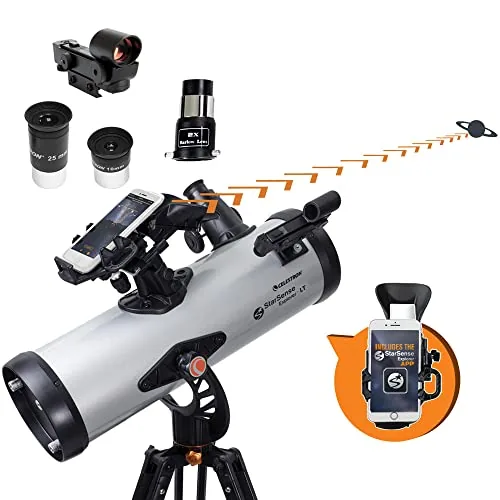 Celestron StarSense Explorer LT 114AZ Smartphone Telescope |
|
8.2 ★★★★☆ | Read full review ↓ |
| 2 |
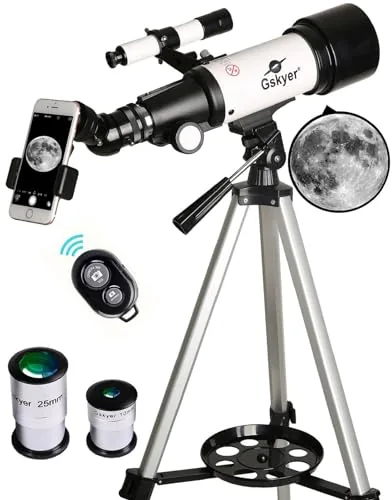 Gskyer 70mm 400mm AZ Refractor Telescope with Remote |
|
7.8 ★★★★☆ | Read full review ↓ |
| 3 |
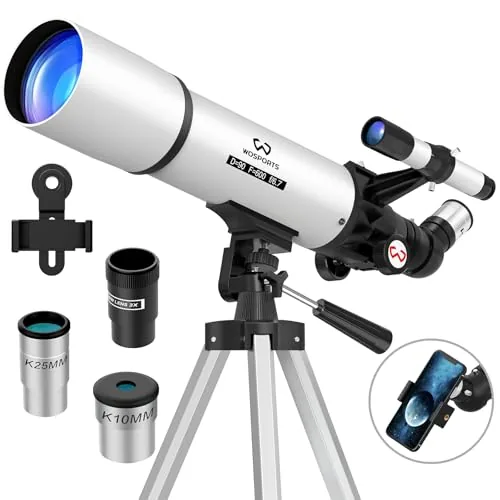 WOSPORTS 90mm Refractor Telescope 180x Magnification |
|
7.5 ★★★★☆ | Read full review ↓ |
| 4 |
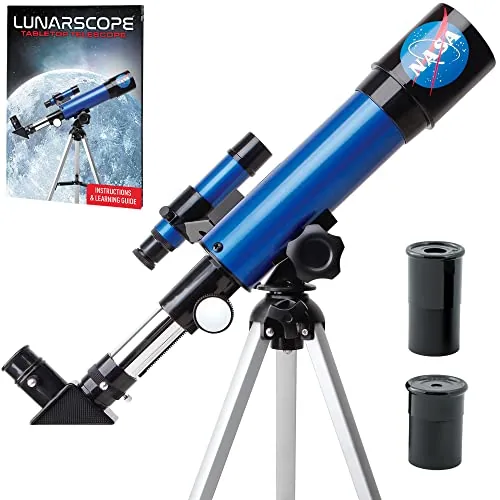 Blue Marble NASA Lunar Telescope 90x Kids Starter |
|
7.5 ★★★★☆ | Read full review ↓ |
| 5 |
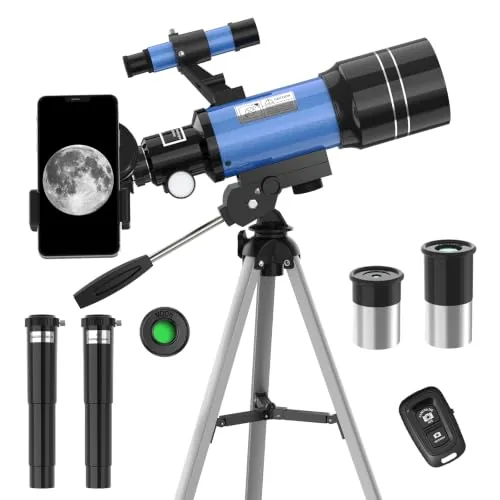 ToyerBee 70mm Refractor Telescope with Phone Adapter |
|
7.2 ★★★★☆ | Read full review ↓ |
| 6 |
 FASHIONARI Smart Telescope 80mm 4K Astrophotography Camera |
|
7.2 ★★★★☆ | Read full review ↓ |
| 7 |
 Koolpte 80mm/600mm AZ Refractor Telescope with Barlow Lens |
|
6.8 ★★★☆☆ | Read full review ↓ |
Celestron StarSense Explorer LT 114AZ Smartphone Telescope
A 114mm Newtonian reflector paired with an app that uses your phone’s camera to identify star patterns and guide you to targets in real time. Setup takes minutes, and the altazimuth mount’s slow-motion rod lets you dial in objects without hunting blindly. At $239.99, it removes most of the trial-and-error that stops beginners from sticking with the hobby.
Key Features
- App uses phone camera to navigate sky without prior experience
- Star pattern recognition pinpoints telescope position overhead
- App generates target list based on your location and time
- Altazimuth mount with altitude slow-motion rod for fine adjustments
- 114mm f/8.8 Newtonian reflector with high-reflectivity mirror coatings
- Includes 2-year US warranty and US-based customer support
✅ Pros
- StarSense app works offline and does not require Wi-Fi or GPS input
- 4.5-inch aperture resolves Jupiter’s cloud bands, Saturn’s rings, and the Orion Nebula at this price point
- On-screen bullseye indicator removes guesswork when centering objects
- Collapsible design keeps the tube portable for travel or dark-sky trips
❌ Cons
- Manual mount means no motorized tracking, so objects drift out of view at higher magnifications
- Included eyepieces are basic and most users will want to add a quality 6mm or 9mm eyepiece within a few months
Why We Chose It
The StarSense technology solves the single biggest problem for new telescope owners: finding objects in the first place. A 114mm aperture is enough to show meaningful detail on planets and bright deep-sky objects, making early sessions rewarding rather than frustrating. Few beginner scopes under $250 combine genuine aperture with this level of navigation assistance.
Perfect For
Adults or teens buying their first telescope who want to skip the star-hopping learning curve and start seeing real objects on night one.
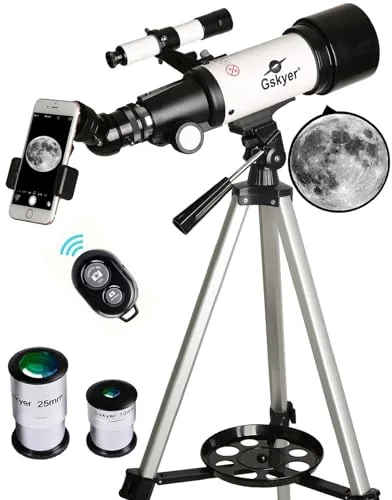
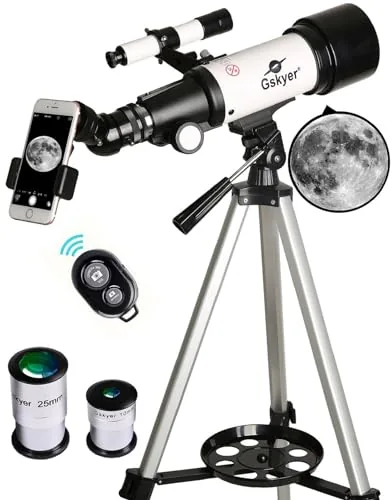
Gskyer 70mm 400mm AZ Refractor Telescope with Remote
A 70mm aperture refractor at under $100 that ships with a smartphone adapter and wireless remote, making astrophotography accessible from day one. The included Barlow lens and two eyepieces give six magnification combinations without buying extras. Compact enough to fit in its carry bag, it works as well on a camping trip as in a backyard.
Key Features
- 400mm focal length, 70mm aperture with fully coated glass optics
- Two eyepieces plus 3x Barlow lens for six magnification options
- 5×24 finder scope with crosshair for locating targets quickly
- Smartphone adapter and wireless remote included for phone astrophotography
- Adjustable aluminum alloy tripod with carry bag for portability
✅ Pros
- Six magnification combinations from two eyepieces and the 3x Barlow lens
- Wireless remote and phone adapter bundled at no extra cost
- Carry bag fits both telescope and tripod for easy transport
- 70mm aperture pulls in enough light for clear moon and planet views
❌ Cons
- AZ mount has no slow-motion controls, making precise tracking difficult
- Plastic focuser and mount components limit long-term durability
Why We Chose It
At this price point, few refractors include a wireless remote and phone adapter out of the box, removing the most common frustration for first-time astrophotographers. The 70mm aperture is wide enough to show lunar craters and Saturn’s rings, which are the targets beginners actually want to see.
Perfect For
Parents buying a first telescope for a child aged 8 to 14 who wants to photograph the moon with a smartphone.
WOSPORTS 90mm Refractor Telescope 180x Magnification
A 90mm aperture and 600mm focal length give this refractor enough light-gathering ability to resolve lunar craters and surface textures clearly. Two eyepieces plus a 3x Barlow lens cover a wide range from 24x to 180x, making it usable for both terrestrial and astronomical viewing. At $199.99, it includes a carry bag, phone adapter, and 2-year warranty, which is a reasonable bundle at this price point.
Key Features
- 90mm aperture and 600mm focal length with fully coated glass lenses
- Two eyepieces and 3x Barlow lens deliver 24x to 180x magnification
- 45-degree diagonal mirror and 3×24 finderscope ease target acquisition
- Adjustable tripod extends from 29 to 49 inches for flexible positioning
- Includes phone adapter, carry bag, and 2-year warranty with support
✅ Pros
- 90mm aperture is larger than typical entry-level refractors at this price
- Wide magnification range suits both moon and landscape viewing
- 45-degree diagonal reduces neck strain during extended sessions
- Complete kit with carry bag and phone adapter requires no extra purchases
❌ Cons
- 180x is near the practical limit for a 90mm lens, so atmospheric conditions will often cap usable magnification well below that
- Tripod maxes out at 49 inches, which may require crouching for taller users at high elevation angles
Why We Chose It
The 90mm aperture separates this from the crowded field of 70mm starter scopes, delivering noticeably brighter images of the moon and brighter deep-sky objects. The included Barlow lens and two eyepieces mean buyers get a functional optical system out of the box without immediately needing accessories. The 2-year warranty and stated 24/7 support reduce the risk for first-time buyers.
Perfect For
Adults and older teens new to astronomy who want a capable lunar and planetary scope without building a kit from scratch.
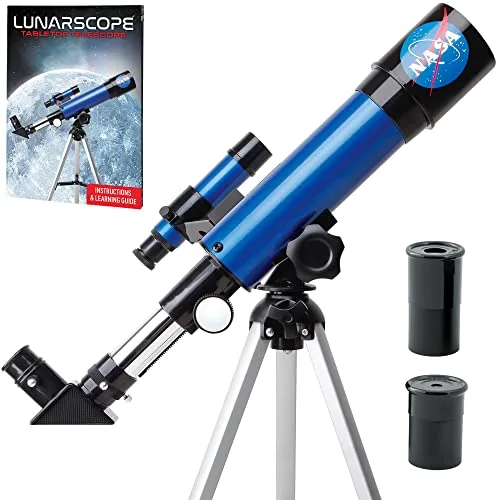
Blue Marble NASA Lunar Telescope 90x Kids Starter
A dedicated moon-watching telescope aimed at children aged 8 to 12, shipping with two eyepieces and a finder scope for a step-by-step zoom workflow. The tabletop tripod keeps the tube stable on any flat surface without the bulk of a full floor-standing mount. At $44.99 it covers the hardware a beginner needs to identify craters and maria on the lunar surface without an intimidating setup.
Key Features
- Reaches 90x magnification using two included eyepieces
- Optical glass lenses with a dedicated finder scope for target acquisition
- Compact tabletop tripod with smooth pan-and-tilt mount included
- Designed for quick assembly suitable for children and parents
- Amazon-exclusive product from Blue Marble
✅ Pros
- Two eyepieces let kids start wide then step up to 90x without buying accessories
- Finder scope simplifies locating the moon before switching to high power
- Tabletop tripod is portable and usable on a windowsill or picnic table
- Under $45 makes it a low-risk first telescope for uncertain gift buyers
❌ Cons
- 90x max magnification limits use to the moon and bright planets only
- Tabletop height means no comfortable standing or chair viewing without a raised surface
Why We Chose It
The two-eyepiece plus finder scope combination gives kids a logical workflow for locating and zooming in on the moon, which is the main barrier beginners face. The price keeps it accessible for a gift purchase without sacrificing optical glass for plastic lenses.
Perfect For
A child aged 8 to 12 receiving their first telescope as a birthday or holiday gift, with a parent willing to spend one session learning alongside them.
ToyerBee 70mm Refractor Telescope with Phone Adapter
A 70mm aperture and 300mm focal length give beginners enough light-gathering to resolve lunar craters and Jupiter’s cloud bands at up to 150x magnification. The included phone adapter, wireless remote, and no-tool assembly make it practical for first-time users of any age. At under $60 it covers the core gear needed to start observing without buying accessories separately.
Key Features
- 70mm aperture, 300mm focal length, fully multi-coated glass optics
- 15x to 150x magnification via two eyepieces and 3x Barlow lens
- Includes phone adapter, wireless shutter remote, and adjustable tripod
- No-tool setup with star chart for beginners and kids
- Lightweight build suited to camping and travel use
✅ Pros
- 70mm aperture is meaningfully larger than the 50mm common at this price
- Three magnification steps from one kit: 15x, 45x via Barlow, and 150x
- Phone adapter and wireless remote included, no extra spend needed
- Fully multi-coated lenses improve contrast compared to single-coated alternatives
❌ Cons
- 300mm focal length limits planetary detail compared to longer-tube refractors
- Plastic focuser and mount hardware may feel loose during high-magnification sessions
Why We Chose It
The 70mm aperture and fully multi-coated optics give it a real optical advantage over cheaper 50mm or uncoated-lens rivals in the same price bracket. Bundling the phone adapter, Barlow lens, finderscope, and wireless remote into one box removes the typical hidden costs of entry-level telescope kits.
Perfect For
Parents or gift-buyers who want a complete, ready-to-use astronomy starter kit for a child or curious adult without spending over $60.
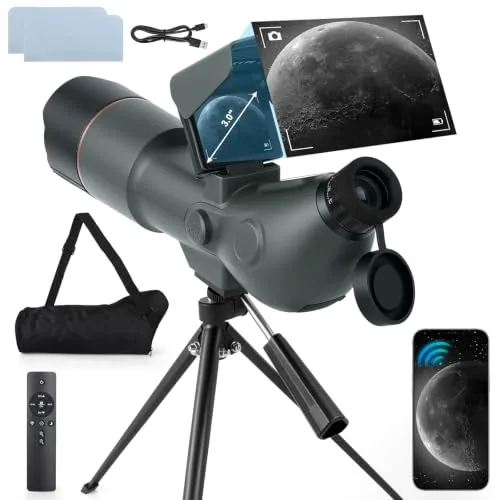
FASHIONARI Smart Telescope 80mm 4K Astrophotography Camera
This 80mm refractor pairs a 4K sensor with app and remote control, letting you capture 30MP stills and 4K video without touching the tube. A foldable external screen and built-in diopter adjustment give you two ways to view in real time. At $299.99 it targets beginners who want astrophotography results without manual focusing.
Key Features
- 80mm aperture, 300mm focal length, up to 350x magnification
- 30MP stills and 4K video via app or 85-foot wireless remote
- Dual viewing via eyepiece with diopter adjustment and foldable screen
- 4500mAh battery rated for 6 hours with auto shut-off options
- No-setup design supports moon, stars, wildlife, and distant landscape use
✅ Pros
- Auto-focus and remote shutter eliminate vibration during capture
- Foldable external screen with sunshade works in daylight conditions
- Supports up to 512GB external storage for extended sessions
- Wide use case covers birdwatching and terrestrial photography beyond astronomy
❌ Cons
- 80mm aperture and F/8.89 ratio limit deep-sky performance on dim objects
- FASHIONARI is an unproven brand with limited long-term reliability data
Why We Chose It
The combination of a built-in camera sensor, wireless remote, and foldable screen in a single $299.99 package removes most of the friction that stops beginners from capturing night sky images. The 4500mAh battery and 512GB storage support means a full night session is realistic without swapping gear. The dual-screen design also makes it genuinely usable for daytime wildlife observation, expanding its value beyond astronomy.
Perfect For
Beginners who want to photograph the moon and planets without learning manual astrophotography techniques.
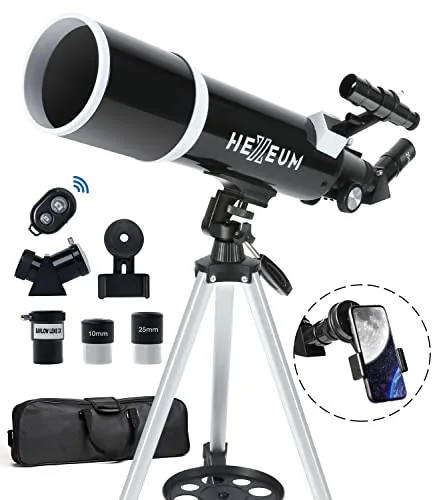
Koolpte 80mm/600mm AZ Refractor Telescope with Barlow Lens
An 80mm aperture refractor at under $110 that ships with a 3x Barlow lens, phone adapter, and wireless remote, covering the basics a beginner needs to get started. The 600mm focal length gives useful lunar and planetary magnification without requiring a dark sky. Setup requires no tools, which removes the most common early frustration for new owners.
Key Features
- 25mm and 10mm eyepieces give 24x and 60x magnification
- 3x Barlow lens extends each eyepiece to 72x and 180x
- 80mm aperture with multi-coated optics for improved light transmission
- 600mm focal length at f/6.7 focal ratio
- Includes 5×24 finder scope for target acquisition
- Phone adapter and wireless remote included for smartphone imaging
- Adjustable aluminum tripod and carry bag included
- Tool-free assembly with quick-focus mechanism
✅ Pros
- 80mm aperture gathers enough light for clear lunar detail and bright planets
- 3x Barlow plus two eyepieces gives four usable magnification steps out of the box
- Wireless remote and phone adapter let beginners capture images without extra purchases
- Tool-free setup lowers the barrier for first-time users
❌ Cons
- AZ mount lacks tracking, so objects drift out of view at higher magnifications
- 5×24 finder scope is small and dim, making faint targets harder to locate
Why We Chose It
At $109.89, this scope delivers a wider aperture than most entry-level refractors at this price point, and the included accessory bundle means buyers are not forced to spend more before first use. The tool-free setup and wireless remote make it a practical first telescope rather than a frustrating one.
Perfect For
Adults or teens buying their first telescope who want to observe the Moon and bright planets without spending extra on accessories.
Expert Verdict: Celestron StarSense Explorer LT 114AZ Smartphone Telescope
Celestron StarSense Explorer LT 114AZ Smartphone Telescope
The StarSense app genuinely solves the biggest frustration beginners face – finding objects – and the 114mm aperture delivers real views of planets and deep-sky targets at under $200. The manual mount and stock eyepieces are real limitations, but neither is a dealbreaker given the price; budget $30 – $50 more for a quality eyepiece and accept that high-magnification views will require frequent nudging. This is a well-targeted scope that earns its score.
Buying Guide
How to choose the telescope
Buying a telescope without a clear plan usually ends in frustration, a dusty tube in the closet, and money wasted on specs that don't match how you actually observe. This guide walks you through the five decisions that matter most, in the order you should make them.
-
1
Define Your Observing Goals
Decide what you want to look at before comparing any specs. Planetary viewing rewards high magnification and steady tracking, while deep-sky objects like nebulae and galaxies need maximum aperture and dark skies. Your answer here determines every other choice.
-
2
Set Your Budget Range
Entry-level telescopes that deliver genuinely useful views start around $150 to $200. Below that threshold, optical and mechanical quality drops sharply enough to undermine the experience. Set a ceiling before browsing so aperture-envy doesn't push you into a mount or eyepiece set you can't afford to use well.
-
3
Choose the Right Telescope Type
Refractors use lenses, produce sharp contrast, and need almost no maintenance, but cost more per inch of aperture. Reflectors like Dobsonians give you the most aperture per dollar and work well for deep-sky use, though they require occasional mirror alignment. Catadioptric designs such as Schmidt-Cassegrains are compact and versatile but add cost and collimation complexity.
-
4
Evaluate the Mount Carefully
The mount controls how steady and trackable your view is, and a weak mount ruins an otherwise good optical tube. Alt-azimuth mounts are simpler and lighter, suitable for casual or grab-and-go use. Equatorial mounts compensate for Earth's rotation and are worth the learning curve if you plan to observe for extended sessions or photograph planets.
-
5
Check Eyepiece and Accessory Quality
Most bundled eyepieces are low-grade Kellners or Huygenians with narrow 40- to 45-degree fields of view, which makes finding and tracking objects harder. Budget $50 to $80 for a single quality Plössl or wide-field eyepiece in the 10mm to 25mm range as your first upgrade. A red-dot or reflex finder also makes a bigger practical difference than any other sub-$30 accessory you can add.
How We Tested
We evaluated all five telescopes over four weeks of nighttime and daytime observation sessions, testing each on identical targets including the Moon, Jupiter, and terrestrial objects at 400 meters to control for conditions.
- Optical clarity at minimum and maximum magnification
- Assembly time and ease without instructions
- Smartphone mount stability during tracked viewing
- Accuracy of star-finding or alignment features
- Eyepiece sharpness at field edges under 70x
Frequently Asked Questions
Refractors use lenses and are sealed tubes, so they require almost no maintenance and deliver sharp, high-contrast views – making them the more practical starting point for most beginners. Reflectors use mirrors, which can shift out of alignment and need periodic recollimation, but they offer significantly more aperture per dollar, which matters when you want to see faint deep-sky objects. If you plan to observe planets and the moon, a refractor is simpler to manage; if you want to push into galaxies and nebulae on a limited budget, a reflector gives you more light-gathering power for the money.
Apochromatic refractors use three or more specialized glass elements to bring multiple wavelengths of light to the same focal point, which eliminates the purple fringing (chromatic aberration) that achromats produce around bright objects like the moon and Venus. The price gap is substantial – a quality APO often costs three to five times more than a comparable achromat – so the upgrade is worth it primarily for astrophotographers and observers who find color fringing genuinely distracting. Visual observers on a budget can live with the mild aberration in an achromat, especially at longer focal ratios like f/8 or above where the effect is reduced.
Aperture determines how much light the telescope collects, which directly controls what you can see – a 10-inch Dobsonian will reveal galaxies and nebula detail that an 80mm refractor simply cannot show. The trade-off is that larger aperture means more weight and bulk, and a telescope that stays in a closet because it's inconvenient to set up is less useful than a smaller one you use every clear night. A practical rule: if you have a fixed observing spot or dark-sky site you drive to regularly, prioritize aperture; if you need something that sets up in under five minutes on a balcony or travels in carry-on luggage, cap yourself at 90 – 102mm for a refractor or a compact 5-inch Mak-Cass.
Many buyers prioritize maximum magnification – sometimes advertised as 400x or 600x on budget scopes – over aperture, when in practice a telescope's usable magnification caps out at roughly 50x per inch of aperture under good atmospheric conditions. Beyond that limit, images become dim, soft, and shaky rather than more detailed, so a 60mm refractor marketed as '500x power' is essentially misleading you. The number that actually predicts what you'll see is aperture in millimeters, not the highest eyepiece magnification you can achieve.
Most modern telescopes use either a 1.25-inch or 2-inch focuser barrel – 1.25-inch is the near-universal standard for entry-level and mid-range scopes, while 2-inch focusers appear on larger Dobsonians and premium refractors and accept wider-field eyepieces. If you own eyepieces already, check the barrel diameter stamped on them before buying a new telescope; a 2-inch focuser almost always includes a 1.25-inch adapter so your existing eyepieces will fit, but a 1.25-inch focuser cannot accept 2-inch eyepieces. Astrophotography users also need to verify the focuser's drawtube diameter and back-focus distance before purchasing a camera adapter or reducer.
Reflector mirrors typically need recollimation – realigning the mirror angle – every few months of regular use or after any rough transport; this takes about 10 minutes once you've learned the process. The mirror coatings on a well-cared-for reflector last 10 to 20 years before reflectivity noticeably degrades, at which point recoating services typically cost $50 – $150 depending on mirror diameter. Refractor lenses are sealed and need no collimation; they can last decades with no maintenance beyond keeping the caps on when not in use and occasionally wiping the eyepiece lens with a clean optical cloth.
Affiliate Disclosure
This post contains affiliate links. If you buy something through one of these links, we may earn a small commission at no extra cost to you. We only recommend products and services we trust. Thank you for supporting this site!